What and How Should Urban Planners Learn in the AI Era? Exploring Urban AI Pedagogy from a Pilot Course in Urban Planning Education
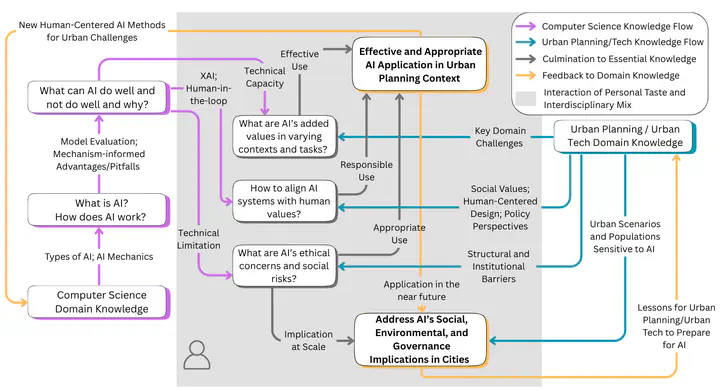 Knowledge Graph of Urban AI (Credit Xiaofan Liang)
Feel free to check out the Urban AI course syllabus and student project portfolio at: https://www.xiaofanliang.com/teaching/
Journal Article: HERE Blog Post with Classroom Observations: HERE Open-Access Preprint: HERE
Introduction
Artificial intelligence (AI) is increasingly used in urban planning research to review planning documents (Brinkley and Stahmer 2024; Fu, Li, and Zhai 2023), analyze zoning codes (Salazar-Miranda and Talen 2025), monitor traffic (Boukerche and Hou 2021), assess urban perception (Ito et al. 2024), classify land uses (Chaturvedi and Vries 2021), simulate urban patterns (Wu, Stouffs, and Biljecki 2022), and inform urban design (Quan 2022). As these applications expand, scholars have begun to examine AI’s conceptual foundations, including the flow of domain knowledge between AI and urban science (Ye et al. 2025; Zheng et al. 2025) and its ethical and societal implications (Sanchez, Brenman, and Ye 2025). Yet the field still lacks enough planners conversant in AI. A recent American Planning Association survey shows cautious adoption and mixed sentiments among practitioners despite broad acknowledgment of AI’s importance (Sanchez et al. 2023).
Few urban planning curricula have incorporated AI content, enabled students to meaningfully leverage GenAI tools in their learning, or even designed a course explicitly addressing the emerging field of Urban AI. This gap leaves educators facing critical uncertainties: What knowledge and skills define Urban AI? How should they be taught? And how can student learning be effectively evaluated? This paper addresses these questions by presenting the pedagogical design and assessment of an Urban AI course offered at University of Michigan. The paper introduces a knowledge graph that characterizes the components and flows of knowledge essential for urban planning and urban technology students in the field of Urban AI, alongside a set of evaluation metrics to assess students’ critical use and thinking with AI tools. These frameworks were refined through feedback from the pilot offering of the course and grounded in hundreds of examples drawn from student reflection journals.
The paper contributes to planning pedagogy in three ways: (1) by proposing an operational teaching framework for faculty seeking to introduce Urban AI into their classrooms; (2) by highlighting key pedagogical tensions and student growth observed through empirical evidence; and (3) by sharing a publicly available syllabus and student final project portfolio (https://www.xiaofanliang.com/teaching/), and lessons learned from the pilot course as starting points for debate, refinement, and co-construction of Urban AI pedagogy. Together, these contributions illustrate how AI can be embedded in domain-specific pedagogy and provide adaptable assessment metrics for strengthening students’ critical AI use and reflective practice, which holds values beyond urban planning.
Keywords: Urban AI, pedagogy, qualitative analysis